
In the case of Thompson v Ragget & others [2018] an unmarried couple lived together for over 42 years prior to the testator’s death in 2017. This case is similar but less acrimonious than Martin v Williams [2017] , also regarding an unmarried couple, with the addition of an estranged spouse. Both cases involve claims for reasonable financial provision and present and
How an Out of Date Will Can Lead to Costly Litigation


Having an out of date Will can mean no reasonable financial provision and lead to unexpected and acrimonious litigation that can be very expensive. The recent case of Martin v Williams [2017] EWHC 491 (Ch) illustrates this as follows:-
Inheritance tax – Residence Nil Rate Band

The HMRC recently released data revealing that in 2018-19, it was a record year for inheritance  tax receipts with a total of nearly £5.4 billion. This is an increase of £2 billion in 2017 -18. One of the factors driving this increase is the rise in the asset values, and in particular residential property. The inheritance tax nil rate band (NRB) has
UpSkirting Now a Criminal Offence
The Voyeurism (Offences) Act 2019 received Royal Assent amends the Sexual Offences Act 2003 Voyeurism and upskirting now a criminal office. Until now offenders could only be prosecuted for voyeurism or outraging public decency. But voyeurism only applies to filming in “private” while outraging public decency usually requires a witness – and upskirting often goes … Read more
Transparency makes things clearer, or does it?
 Six months on from the introduction of the SRA Transparency Rules it is surprising to hear that some firms are yet to comply with the new obligations. The Solicitors Regulation Authority (SRA) recently published (June 2019) the results of its Transparency Rules Web Sweep showing nearly 58% of firms were partially complying and 17% were not complying at all.
Accredited Legal Representatives in the Court of Protection
The Law Society has published new practice guidelines for lawyers seeking appointment, or acting, as accredited representatives in the Court of Protection.
Upcoming Posts in the coming months
1. Practice guidance for Lawyers seeking apppointment as accredited Legal Representatives in the Court of Protection/ 2. Dependant claims by Testator’s adult children – Nahajec v Fowle [2017] 3. Unmarried partners – property rights – Lewis (as Executrix of the Estate of Blackwell, deceased) v Warner [2017] 4. Court of Protection – Protection of Trust … Read more
Cost of Death Certificates Rises
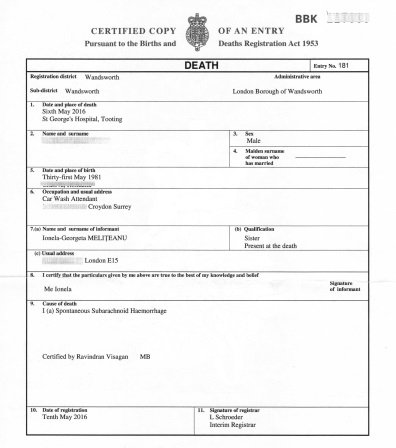
A three-fold rise in the cost of a death certificate could result in solicitors being unable to administer some estates, lawyers have warned. The General Register Office this month increased the cost of obtaining a certificate online from £4 to £11.
Charlotte Pritchard, a member of the private wealth team at national firm BLM, told the Gazette it is not unusual for families to require between 10-20 death certificates in order to administer an estate. She warned that where solicitors are appointed payment may need to be initially funded by the firm; particularly if no family members are able to find the up-front cash.
Lawyers warned over potentially negligent GDPR advice

A legal compliance expert has warned that lawyers may need to take action over potential breaches of data protection rules.
Brian Rogers, Director of Regulation and Compliance Services for Riliance, said those who advised businesses how to comply with new GDPR rules last May should revisit that advice – and even contact clients to admit they made a mistake.
Rogers spoke to the Gazette after lawyers were publicly criticised last month by Chris Combemale, Chief Executive of the marketing network DMA Group. Combemale told a Westminster Legal Policy Forum conference that many of the 1,000 DMA members had been wrongly told to focus on consent as the basis for processing data.
A worker’s minimum holiday pay under EU law. Can it be reduced to reflect short-time working?

In the case of Hein v Albert Holzkamm GmbH a construction worker in Germany working under a collective agreement. The collective agreement provided that holiday pay would be paid on the basis of a 13-week average calculation. This calculation of holiday pay was in accordance with the national law in Germany. After a 26-week lay-off, his holiday pay was calculated on the basis of this 13 week average, excluding overtime.
European Directive
Consequently, this meant that it was lower than his normal pay, in breach of Article 7(1) of Directive (EC) 2003/88. [note] Article 7(1), Annual leave
1. Member States shall take the measures necessary to ensure that every worker is entitled to paid annual leave of at least four weeks in accordance with the conditions for entitlement to, and granting of, such leave laid down by national legislation and/or practice.
2. The minimum period of paid annual leave may not be replaced by an allowance in lieu, except where the employment relationship is terminated.[/note] This Directive relates to certain aspects of the organisation of working time of the EU Member States.