

The Employment Rights Bill: Transformative Changes for Workers and Employers

The Employment Rights Bill, which passed its final parliamentary hurdle in December 2025 and received Royal Assent on the 18th. The new Act represents the most significant overhaul of UK employment law in a generation. Once implemented, this legislation will fundamentally reshape the relationship between employers and workers across England, Scotland, and Wales, introducing sweeping … Read more

Employee Rights at State Pension Age

Employee Rights

Employee Rights at State Pension Age: Comprehensive Protection from Forced Retirement and Age Discrimination The fundamental legal position is clear: you cannot be forced to retire simply because you reach state pension age in the UK. Since the abolition of the Default Retirement Age in October 2011, the law provides robust protection against age discrimination … Read more

UK Workplace Temperature Regulations

uk-workplace-temperature regulations

UK Workplace Temperature Regulations: From Minimum Standards to Maximum Heat – A Legal Analysis of Climate Adaptation in Employment Law   The Office Shops and Railway Premises Act 1963 established a crucial precedent by setting a minimum workplace temperature of 16°C for office work, representing one of the earliest statutory recognitions that workplace temperature directly … Read more

Significant UK Age Discrimination Cases Reported in 2024

 UK Age Discrimination Cases from Harassment to Commissioner to Protect Older Worker’s Rights, reported in 2024 Age UK ordered to pay £4,000 after losing age-related harassment case – Age UK was fined for harassing an older worker during a job application process, resulting in a £4,000 compensation for injury to feelings. Age UK fined £4,000 … Read more

Some Significant Age Discrimination Cases Reported in 2023

Here are some of the most significant age discrimination cases reported in the UK in 2023: Eileen Jolly vs. Reading’s Royal Berkshire Hospital1: An 89-year-old NHS secretary, Eileen Jolly, became the oldest person in the UK to win an age discrimination claim. Her superiors at Reading’s Royal Berkshire Hospital fired her, claiming that she was … Read more

Retail worker sacked for Smoking

Employers have to be extra careful when dismissing employees. Even if employees have committed acts of gross misconduct, dismissing them may be unreasonable. An Employment Tribunal (ET) made this remark in a case where a store supervisor was sacked for smoking on company premises. The woman worked for a national retail chain which took a … Read more

The Implications of Harpur Trust v Brazel for Schools and Academy Trusts

Harpur Trust v Brazel  Earlier this year, the Education and Skills Funding Agency (ESFA) released a guide that outlined the requirements for school and academy trusts to deal with complaints. The guide contained a case study based on the recent case of Harpur Trust v Brazel, which provides an interesting background to the issue and … Read more

Age Discrimination in the UK: Employer Justified Retirement Age

Age Discrimination in the UK The law protects employees from discrimination based on their age in a number of ways. Age discrimination, also known as compulsory or justified retirement age, is one such practice. It can occur when an employer does not respect an employee’s age, whether it’s directly or indirectly. Justified retirement age The … Read more

CORONAVIRUS AND CONTRACTS: FORCE MAJEURE

The outbreak of coronavirus (also known as COVID-19) is having a significant impact on the ability of businesses to perform their contracts. As of 03 March 2020 there have been 2809 cases reported and 56 deaths. It is very likely to get much worse in the UK before it gets better. Businesses have to be … Read more

Zero Hours or Contracts with No Guaranteed Hours of Work

Zero hour contracts

A zero hour contract  is just as it sounds, a contract with zero hours or to put it another way, a contract with no guaranteed hours of work. In other words workers are not guaranteed any hours of work whatsoever from an employer/agency. Zero hour contracts are widely used in many sectors including the public … Read more

A worker’s minimum holiday pay under EU law. Can it be reduced to reflect short-time working?

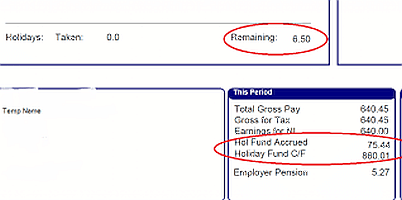
In the case of Hein v Albert Holzkamm GmbH  a construction worker in Germany working under a collective agreement. The collective agreement provided that holiday pay would be paid on the basis of a 13-week average calculation. This calculation of holiday pay was in accordance with the national law in Germany. After a 26-week lay-off, his holiday pay was calculated on the basis of this 13 week average, excluding overtime.

European Directive

Consequently, this meant that it was lower than his normal pay, in breach of Article 7(1) of Directive (EC) 2003/88. [note] Article 7(1), Annual leave
1. Member States shall take the measures necessary to ensure that every worker is entitled to paid annual leave of at least four weeks in accordance with the conditions for entitlement to, and granting of, such leave laid down by national legislation and/or practice.
2. The minimum period of paid annual leave may not be replaced by an allowance in lieu, except where the employment relationship is terminated.[/note]  This Directive relates to certain aspects of the organisation of working time of the EU Member States.

Read more

Google must delete links to articles in “Right to be Forgotten” case

Google was ordered to take down links to articles about the historic criminal convictions of a businessman.

Two businessmen (NT1 & NT2) convicted of criminal offences many years ago brought claims made under Data Protection law and the English law tort of misuse of private information, for the “right to be forgotten” or, more accurately, the right to have personal information “delisted” or “deindexed” by providers of internet search engines (“ISEs”)

Read more

Can My Employer Reduce My Hours?

Question

“I need to know can my employer reduce my hours? I am the manager of a taxi firm and work 39 hours per week Monday to Friday.  I am worried, can my employer reduce my hours? My boss used to drive my autistic son to his special school until an incident occurred and he refused to take my son on this contract. I reported him to licencing for driving while talking on his mobile. Things have never been the same since and he has now reduced my hours to 16 hours with immediate effect. I will only be working two days a week on minimum wage. He said I can use my holidays this week and start back next Thursday 31st March. My other problem is that he took on a part timer about three weeks ago and this doesn’t affect him, whereas I’ve been here for well over five years. I’m also concerned that he pays other people cash in hand to cover some shifts in the office.”

“Please can you tell me my rights, as I need to inform working/child tax that I’m going part time.  Can he legally do this to me?  He says things are financially strangling him and will cover my shifts. I’m paid cash, fully on the books, get a weekly wage slip along with a weekly wage.   I claim working tax and child tax credits and am the sole earner in our household. I have never received a written contract, but so far, he’s stuck to all aspects of employment law i.e. 28 days holidays etc and the correct minimum wage.”

Read more

GDPR, References and Confidential Information

The GDPR impacts on the giving of references and supplying confidential information
Employers are advised to write a clear policy on the giving of references. The ICO (Information Commissioner’s Office) has said employers should have a clear policy setting out, which employees are authorised to give references and in what circumstances.

Read more

Data Processors and the General Data Protection Regulation (GDPR)

Data Protection
Whether you are a Data Controller or a Data Processor you have responsibilities under the General Data Protection Regulation (GDPR). A controller determines the purposes and means of processing personal data, whereas a processor is responsible for processing personal data on behalf of a controller and you are required to maintain records of personal data and processing activities.

Read more

Data Protection and Subject Access Requests

subject access requests - data protection

An increasing number of subject access requests have been made under the Data Protection Act 1998.

Subject access requests are used as tactical ploys as a way of putting pressure on the other side to disclose documents that would not otherwise be disclosable in litigation. Several cases have been

Read more

Notice period for termination of a contract

In the case of Newcastle’s NHS v Haywood (2017) EWCA Civ 153 the question of when does notice of termination of a contract take effect was considered. The best practice is for express provision in a contract of employment to specify when notice will be effective. The alternatives are common law principles that need consideration and the question to be asked is, when does contractual notice take effect on, 1. Posting of a letter 2. Delivery of the letter or 3. Communication of the notice to the employee so they are aware of it?

Read more

Confidential Information – Damages

Where two employees of a large asset management firm were sued for £15 million for taking confidential information, but the employer’s only recovered £2 (nominal damages). The reason for this is that the employees had made no use of the confidential information. Therefore the employer had suffered no losses – Marathon v Seddon [2017] EWHC 300. This serves as a useful reminder to employers suing former

Read more

Dress code-religious and political

dress code- religious and political

In the case of Achbita v G4S [2017] (CJEU, C-157/15), the ECJ has given guidance on the extent to which dress codes (whether formal or informal) can be imposed on those who want to wear religious or political signs. The guidance is that it will be potentially indirect discrimination unless the employer can objectively justify the dress code. … Read more

This site provides general information about the law of England and Wales. It is not legal advice and does not create a solicitor–client relationship. The law changes, and how it applies depends on the facts of your situation. Take advice from a qualified solicitor before acting on anything you read here.