Selling ebooks, courses, software, templates or SaaS subscriptions across borders looks simple from a checkout-button perspective, but underneath sits a dense layer of tax, data protection, consumer-rights and payments law that differs sharply between the UK, the US, Canada, Australia and the wider EU. A creator based in England selling to customers in Los Angeles, Toronto, Sydney and Dublin is simultaneously subject to UK VAT rules, US state sales tax regimes, Canadian GST/HST, Australian GST, EU VAT via the One Stop Shop, and at least two major data protection regimes (UK GDPR/EU GDPR and various US state privacy laws). Getting this right is not optional box-ticking — regulators in every one of these jurisdictions actively enforce against digital sellers, and payment processors will suspend accounts that fall foul of tax or consumer-protection obligations.
This article works through the main compliance domains — value-added and sales tax, data protection and consent, consumer rights and support obligations, currency and payments, and the role of the “merchant of record” — with a practical focus on the UK as home jurisdiction selling into the US, Canada, Australia, Ireland and the rest of the EU.
For a practical example of building and scaling digital product businesses, see the resources at a-digitallife.com.
What Counts as a “Digital Product” for Tax Purposes
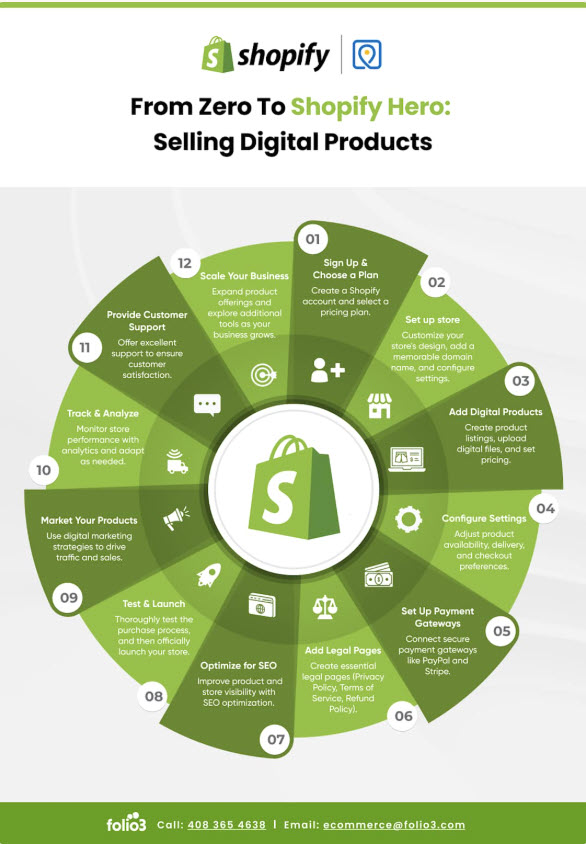
Shopify digital products infographic
Tax authorities generally define a digital or “electronically supplied” product as one delivered automatically over the internet with minimal or no human intervention. HMRC’s definition captures ebooks, downloadable software, apps, stock photography, music, pre-recorded online courses, membership sites and SaaS subscriptions. This matters because the tax treatment of digital goods is frequently different — and often stricter — than for physical goods or products involving substantial live human input (such as bespoke consulting, which is usually taxed differently).[^1]
The classification also affects VAT rate. In the UK, ebooks were zero-rated in 2020 to align with print books, while most other digital content (software, SaaS, single-game keys, gift cards) sits at the standard 20 percent rate. Ireland zero-rates ebooks and educational content, and France applies a reduced 5.5 percent rate to ebooks, but the EU standard rate applies to almost everything else.[2][3]
VAT in the UK and EU: Place-of-Supply Rules
The single most important rule for UK-based digital sellers is that VAT on business-to-consumer (B2C) digital sales is charged at the customer’s country rate, not the seller’s home rate — the opposite of the general rule for most services. For UK domestic sales, the position is more familiar: VAT registration is required once UK taxable turnover exceeds £90,000 in a rolling 12-month period, after which the standard 20 percent rate applies to digital sales with no threshold relief.[2][4]
Once a UK seller starts selling to EU consumers, the picture changes completely. Because the UK left the EU VAT area, there is no threshold for non-EU sellers — VAT is due on the very first B2C sale to an EU consumer, at the rate of that consumer’s country, ranging from 17 percent in Luxembourg to 27 percent in Hungary. Rather than registering for VAT separately in all 27 member states, UK sellers register once for the EU’s non-Union One Stop Shop (OSS) scheme, charge the correct local rate at checkout, and file a single consolidated quarterly return covering all EU consumer sales. This OSS registration is entirely separate from, and additional to, UK VAT registration — a seller can be below the UK’s £90,000 threshold and still be legally required to register for OSS from their very first EU sale.[1][3][^4]
For business-to-business (B2B) sales, the position is simpler. Where the buyer is VAT-registered and provides a valid VAT number verified through the EU’s VIES system, the transaction typically falls outside the scope of UK VAT and the reverse charge mechanism applies — the business customer self-accounts for VAT in its own country, and the UK seller invoices at 0 percent, provided evidence of the buyer’s business status is retained.[1][2]
| Market | Threshold for non-resident B2C sellers | Standard digital VAT/GST rate | Registration mechanism |
| United Kingdom | Nil for non-UK sellers | 20% | HMRC VAT registration |
| EU (as a UK seller) | Nil (no threshold for non-EU sellers) | 17–27% (destination country) | Non-Union OSS |
| Canada | CAD 30,000/12 months | 5% GST (plus provincial HST 13–15% in participating provinces) | Simplified GST/HST registration |
| Australia | AUD 75,000/12 months | 10% GST | ATO simplified GST registration |
Sales Tax in the United States: A State-by-State Patchwork
The US has no federal sales tax and no unified digital services tax, which makes it the most fragmented jurisdiction a UK seller will encounter. Around 30 states levy sales tax on digital products, but the definitions and exemptions vary enormously state by state. States such as Alabama, Arizona, Colorado, Connecticut, Hawaii, Ohio, Pennsylvania, Texas, Washington and Wisconsin explicitly tax most digital products, while Alaska, California, Delaware, Florida, Montana, New Hampshire, Nevada and Oregon generally exempt them. Texas taxes digital goods only where the tangible equivalent would also be taxable.[5][6]
The 2018 US Supreme Court decision in South Dakota v. Wayfair fundamentally changed exposure for remote sellers by ruling that a state can require sales tax collection based purely on economic activity, with no physical presence required. Most states now apply an economic nexus threshold — commonly $100,000 in sales or 200 transactions within the state in a year — beyond which registration and collection become mandatory. A UK-based seller shipping digital downloads to customers across all 50 states must therefore track sales and transaction counts by state on a rolling basis, and register for a sales tax permit the moment any given state’s threshold is crossed. Physical presence — employees, a warehouse, even attending a trade show — also independently creates nexus regardless of sales volume.[7][5]
Canada, Australia and Other Common-Law Markets
Canada requires non-resident vendors selling cross-border digital products to “specified Canadian recipients” to register under a simplified GST/HST regime once sales exceed CAD 30,000 in any rolling 12-month period, a rule in force since 1 July 2021. The rate charged depends on the buyer’s province: 5 percent GST in most provinces, rising to 13–15 percent HST in participating provinces such as Ontario, Nova Scotia and the Atlantic provinces. If the Canadian buyer is itself GST/HST-registered and supplies its registration number, the seller does not need to charge tax on that transaction.[8][9][^10]
Australia applies a flat, unusually simple 10 percent GST to digital sales with a single AUD 75,000 threshold that applies equally to resident and non-resident sellers — there are no reduced rates, no state variations and no digital-specific surcharges. Beyond tax, Australia’s Consumer Law (ACL) is notably assertive about digital goods: the consumer guarantees for acceptable quality, fitness for purpose and correspondence with description apply to software, apps, streaming subscriptions and other digital products exactly as they apply to physical goods, and overseas sellers who actively market to or accept payment from Australian consumers are bound by the ACL even without a local presence. The competition regulator, the ACCC, has litigated against sellers — including a landmark case against Valve Corporation — for terms purporting to exclude these guarantees, establishing that “no refunds” clauses cannot override statutory consumer rights.[11][12][13][14][^8]
Data Protection and Consent: GDPR, UK GDPR and US State Privacy Laws
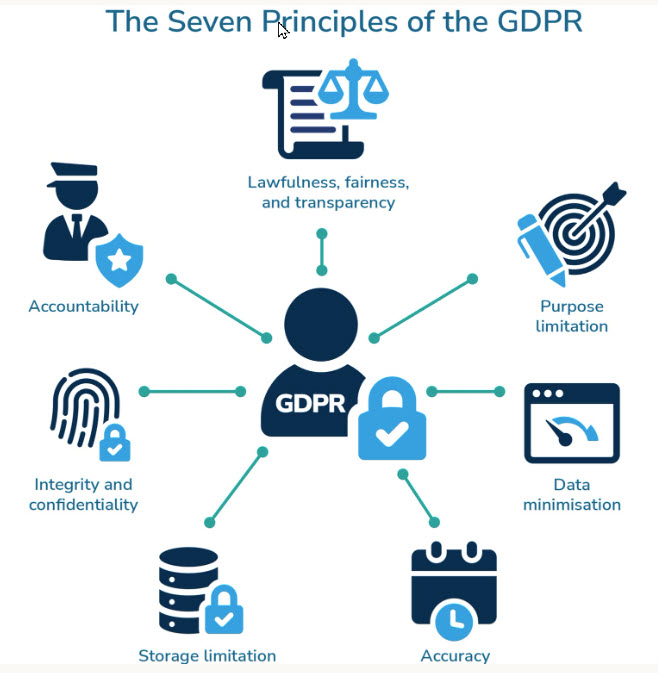
Seven GDPR Principles Diagram
Any UK seller with EU or UK customers is bound by GDPR (or UK GDPR post-Brexit) regardless of business size — there is no small-business exemption, and a one-person operation selling ebooks to EU customers has the same core obligations as a multinational. GDPR applies whenever a business is based in the EU/UK, offers goods or services to people in the EU/UK (even free ones), or monitors the online behaviour of EU/UK residents.[^15]
Practical compliance requirements for a digital product seller include:
- A clear, accessible privacy policy explaining what personal data is collected, the legal basis for processing, third parties data is shared with, retention periods and how customers can exercise their rights.[^15]
- Genuine opt-in consent for marketing emails — pre-ticked boxes are not valid consent, marketing consent must be separated from other consents, and records of when and how consent was given must be kept.[^15]
- Cookie consent banners that block non-essential (analytics/advertising) cookies until the user actively agrees — a user closing a pop-up without clicking “accept” does not constitute consent under recently tightened rules.[16][15]
- Vetting of third-party processors (email platforms, payment processors, analytics tools) for their own GDPR compliance, since liability can flow through the supply chain.[^15]
- A functioning process to handle subject access, correction and deletion requests within statutory time limits.[^15]
On the US side, California’s Consumer Privacy Act (CCPA), significantly amended with effect from 1 January 2026, imposes obligations that catch many digital sellers with California customers if they meet revenue or data-volume thresholds (over $25 million gross annual revenue, or buying/selling/sharing personal data of 100,000+ consumers, or deriving 50 percent of revenue from data sales). The 2026 amendments require businesses to visibly confirm that an opt-out signal — including the Global Privacy Control (GPC) browser signal — has been honoured, ban “dark patterns” in consent interfaces (such as asymmetric accept/decline buttons or false urgency), extend the right-to-know lookback period indefinitely rather than capping it at 12 months, and mandate documented risk assessments before high-risk processing such as selling personal data or using automated decision-making. Even sellers well below the CCPA thresholds should treat these as a useful baseline for good practice given the direction of travel across other US states adopting similar comprehensive privacy statutes.[17][18][19][20]
In the UK context, the ICO (Information Commissioner’s Office) enforces the UK GDPR equivalent, and the FTC in the US separately enforces general rules against deceptive online advertising and marketing — requiring that disclaimers and disclosures be clear, conspicuous, and that promised refunds actually be honoured. The FTC’s INFORM Consumers Act also imposes identity-verification and disclosure duties on high-volume third-party sellers using online marketplaces.[21][22]
Consumer Rights, Cancellation and Support Obligations
UK law treats the sale of digital content as a “distance contract” under the Consumer Contracts (Information, Cancellation and Additional Charges) Regulations 2013, giving consumers a 14-day cooling-off period during which they can cancel without giving a reason. Crucially, for digital content not supplied on a tangible medium (a downloaded ebook, streamed course, or software licence), the trader must obtain the consumer’s express consent to begin supplying the content before the 14 days expire, together with an acknowledgment that the consumer thereby loses their cancellation right — without both of these, the customer retains a right to cancel and receive a full refund even after the download has occurred. The Consumer Rights Act 2015 separately gives buyers of digital content a right to a full refund if the trader never had the legal right to supply that content in the first place, and a right to repair, replacement or partial/full price reduction if the content is faulty, not as described, or unfit for purpose.[23][24][25][26][27][28]
Refunds must be issued without undue delay and within 14 days of the trader agreeing a refund is due, generally paid back via the original payment method. UK credit card purchases between £100 and £30,000 also carry Section 75 protection, making the card issuer jointly liable with the seller for breach of contract or misrepresentation — a consumer safeguard that indirectly raises the bar for sellers, since disputed charges can be reversed by the card issuer regardless of the seller’s own refund policy.[29][26][^28]
Support obligations flow naturally from these consumer-rights regimes: a seller must provide a working contact channel, respond to complaints, and — under both UK and Australian law — cannot use terms of service to disclaim statutory guarantees. The Australian Consumer Law explicitly prohibits sellers from limiting or excluding consumer guarantee rights through their terms, and doing so is itself a further breach that can trigger separate regulatory action.[13][14]
Currency, Payments and Chargebacks
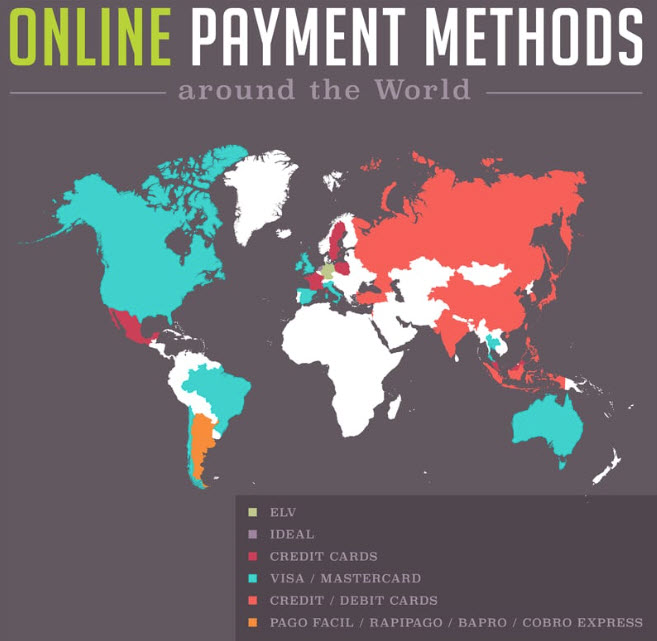
World map of online payment methods
Selling worldwide means displaying and settling prices across multiple currencies, and it means accepting that fraud, chargeback and dispute risk scales with the number of countries served. Localised checkout — showing prices in the customer’s own currency at prevailing exchange rates — improves conversion rates but adds a layer of currency-risk and reconciliation complexity that most solo sellers are not equipped to manage in-house.
Card payment disputes and chargebacks are a particular risk for digital goods, since intangible products cannot be “returned” in the way physical goods can, making fraudulent chargeback claims harder to contest with delivery evidence. Whoever is legally the seller on the transaction — the platform’s name on the customer’s bank statement — bears primary liability for managing these disputes with the card networks and acquiring bank.[^30]
The Merchant of Record Model: Why It Matters
This is where the “merchant of record” (MoR) concept becomes central to a compliant global digital-sales operation. An MoR is the legal entity that is the seller in a transaction — its name appears on the customer’s payment statement, it holds the acquiring relationship with the card networks, and it assumes full responsibility for tax calculation, collection and remittance, PCI compliance, fraud screening, refunds and chargeback handling. This differs fundamentally from a plain payment service provider (like a standard Stripe integration), which merely moves money from the buyer’s bank to the seller’s bank while leaving all tax, compliance and legal-seller obligations with the underlying business.[31][32][30][33][^34]
Under the MoR model there are technically two transactions: one between the end customer and the MoR (who is legally the seller), and a second between the MoR and the underlying business (who receives revenue net of the MoR’s fee and the tax already deducted). For a solo seller or small business, this arrangement removes the single biggest compliance burden of selling digital products internationally — the need to register for VAT in dozens of EU states, sales tax in dozens of US states, and GST in Canada and Australia individually.[35][36][37][31]
| Platform | Merchant of record? | Typical fee | Best suited to |
| Paddle | Yes | 5% + $0.50 per transaction | Growth-stage SaaS, subscriptions[38][37] |
| Lemon Squeezy (Stripe-owned) | Yes | 5% + $0.50, +0.5% subs, +1.5% international cards | Indie SaaS, software, digital products[39][40] |
| Gumroad | Yes, since 1 January 2025 | 10% + $0.50 direct; 30% via Discover marketplace | Solo creators, ebooks, templates, courses[39][41][^40] |
| Stripe (standard) | No — seller remains merchant of record | 2.9% + $0.30 (tax handled separately via Stripe Tax) | Sellers willing to manage their own tax registration/filing[37][42] |
| FastSpring | Yes | Custom, roughly 5–9% | Established software companies at scale[43][44] |
Choosing an MoR platform such as Paddle, Lemon Squeezy or Gumroad effectively outsources VAT/GST/sales-tax calculation, collection and remittance across essentially every jurisdiction covered in this article, in exchange for a transaction fee meaningfully higher than a bare payment processor. This trade-off is usually the right one for individual creators and small businesses without in-house tax or legal resource, since the compliance cost and risk of getting international tax wrong — audits, penalties, blocked payouts — generally exceeds the extra percentage points charged by an MoR. Larger, established software businesses with dedicated finance teams sometimes migrate away from an MoR toward direct processing plus a tax-automation tool (such as Stripe combined with a tax engine) once volumes justify the operational overhead of registering and filing directly in each jurisdiction.[39][42][41][40][44][35]
Bringing It Together: A Practical Compliance Checklist
A UK-based seller of digital products targeting the main English-speaking markets — the UK, Ireland, the US, Canada and Australia — plus the wider EU should work through the following before going live:
- Decide whether to be your own merchant of record (handling VAT/GST/sales tax registration and filing across every jurisdiction where thresholds are crossed) or to route sales through an MoR platform that absorbs this burden for a transaction fee.[31][39]
- Register for UK VAT once the £90,000 threshold is crossed, and separately register for the EU’s non-Union OSS scheme from the first B2C sale to any EU consumer, since the OSS threshold for non-EU sellers is effectively nil.[1][2]
- Track US sales by state against each state’s economic nexus threshold (commonly $100,000/200 transactions), and register for sales tax permits in states where thresholds are crossed and the state taxes the specific digital product type sold.[5][6]
- Register for Canada’s simplified GST/HST regime once CAD 30,000 in sales to Canadian consumers is exceeded, and for Australian GST once AUD 75,000 is exceeded — noting Australia’s threshold applies identically to residents and non-residents.[9][11]
- Publish a GDPR/UK-GDPR compliant privacy policy, implement a compliant cookie-consent mechanism, and use genuine opt-in (not pre-ticked) consent for marketing communications.[^15]
- If California customers are significant, review CCPA 2026 obligations around opt-out signal confirmation, dark-pattern prohibitions and risk assessments.[17][20]
- Build in the mandatory UK 14-day cancellation right for digital content, with an explicit “express consent to waive cancellation rights” checkbox at the point of purchase if immediate access is to be granted.[25][27]
- Ensure terms of service do not purport to exclude statutory consumer guarantees in the UK, Australia or elsewhere — such clauses are themselves potentially unlawful and have been the subject of regulatory enforcement action.[28][14]
- Provide clear, honest, non-deceptive marketing claims and an accessible support channel, consistent with FTC advertising rules and equivalent UK/Australian requirements.[21][22]
-
Further reading: a-digitallife.com covers strategies for selling digital products globally.
Sources
- Paddle — “What is a merchant of record (MoR)?” (2024)
- VATChecker — “VAT on Digital Products & Online Courses in the UK” (2026)
- FoxReload — “UK VAT for Digital Services 2026: Post-Brexit Guide” (2026)
- BooksTime — “What is a Merchant of Record (MoR)?” (2026)
- StoreEngine — “How to Sell Digital Products in Europe (2026): VAT, OSS” (2026)
- TaxJar — “Sales tax by state: digital products” (2026)
- HandsOffSalesTax — “Sales Tax on Digital Products Explained” (2026)
- DodoPayments — “Merchant of Record for Solo Builders Selling Digital Products”
- io — “Merchant of Record: Definition, How It Works”
- SubscriptionFlow — “Understanding the Importance of a Merchant of Record for Digital Products” (2024)
- Avalara — “US digital services sales tax” (2025) and “Global VAT and GST on digital services” (2026)
- CreatorLaunch — “What Is a Merchant of Record?” (2026)
- FastSpring — “What Is a Merchant of Record?” (2025)
- PlainVAT — “Digital services VAT – place of supply – EU and UK VAT guide” (2026)
- Stripe — “What Is a Merchant of Record?” (2023)
- UK — “Accepting returns and giving refunds: the law”
- UK Government — “Consumer Rights In Digital Products – Research Report”
- Bromley Council — “Supply of digital content: your consumer rights”
- Pinsent Masons — “New distance selling rules among new UK consumer protection law reforms” (2019)
- UK Government BIS — “Consumer contracts (information, cancellation and additional charges) guidance”
- SendOwl — “The complete tax and VAT guide for digital product sellers” (2026)
- Civil Help — “Online Shopping Rights UK | 14-Day Cancellation CCRs” (2026)
- UK Government — “Information requirements and right to withdraw for distance contracts”
- UK Legal Guides — “Distance Selling Rules: Your Rights When Buying Online” (2026)
- UK Parliament — Commons Library briefing on Consumer Contracts Regulations 2013
- gov.uk — Consumer Rights Act 2015, Explanatory Notes
- Canada Revenue Agency — “Cross-border digital products or services: GST/HST” (2024)
- Canada Revenue Agency — Notice 322, recovery of GST/HST under digital economy measures (2022)
- California Privacy Protection Agency (CPPA) — CCPA regulations effective 1 January 2026
- Greenberg Traurig — “Revised and New CCPA Regulations Set to Take Effect on Jan. 1, 2026” (2025)
- AI Privacy Center — “CCPA Risk Assessments, the Delete Act, and New Opt-Out Rules” (2026)
- National Law Review — “California Consumer Protect Act Brings Sweeping Changes in 2026” (2025)
- Jackson Lewis — “Navigating the California Consumer Privacy Act: 30+ Essential FAQs” (2026)
- Paul Hastings — “Plan Ahead: Updated CCPA Regulations Go Into Effect Jan. 1” (2025)
- California Attorney General — “California Consumer Privacy Act (CCPA)”
- VinciWorks — “New California Consumer Privacy Act rules from 1 January 2026” (2025)
- Kiteworks — “CCPA 2026 Compliance: Navigate California’s New Privacy Rules” (2026)
- MakePrivacyPolicy — “GDPR for Small Business: A Complete Guide” (2026)
- Federal Trade Commission — “Advertising and Marketing on the Internet: Rules of the Road” and “Online Advertising and Marketing”
- AIBizHub — “Gumroad vs Lemon Squeezy vs Paddle 2026 Compared” (2026)
- The Software Scout — “Lemon Squeezy vs Paddle 2026” (2026)
- Global Solo — “Stripe vs Paddle vs Lemon Squeezy vs Gumroad 2026” (2026)
- GetStackSmart — “Lemon Squeezy vs Stripe vs Paddle: Merchant of Record 2026” (2026)
- Freemius — “Top 7 merchant of record providers by SaaS stage” (2026)
- Creem — “Best Merchant of Record for SaaS in 2026” (2026)
- AIStackPicks — “Lemon Squeezy vs Gumroad 2026” (2026)
- GumKit — “Gumroad vs Lemon Squeezy (2026)” (2026)
- to — “Lemon Squeezy Alternatives & Competitors 2026” (2026)
- Hacker News — “Which payment processor/merchant-of-record do you use in 2026?”
- DodoPayments — “Cheapest Merchant of Record for SaaS in 2026” (2026)
- ACCC — “Booktopia in court for alleged false or misleading claims on refund rights” (2021)
- RecordingLaw — “Online Shopping Rights in Australia Under the Consumer Law” (2026)
- SprintLaw — “ACCC v Valve Corporation | Business Law Cases”
- ACCC — “Selling online” (2026)
References
- VAT on Digital Products & Online Courses in the UK – Do you charge VAT on ebooks, online courses, software, and digital downloads sold in the UK? Place-o…
- UK VAT for Digital Services 2026: Post-Brexit Guide – UK VAT on digital services in 2026: £90k registration threshold, 20% standard rate, HMRC filing, B2B…
- How to Sell Digital Products in Europe (2026): VAT, OSS & What … – Learn how to sell Digital Products in Europe in 2026 with EU VAT, OSS, UK VAT, B2B vs B2C rules, com…
- Digital services VAT – place of supply – EU and UK VAT guide … – Place-of-supply rules for B2C digital services, OSS reporting, and the destination-country default.
- Sales Tax on Digital Products Explained – Digital product taxes vary wildly by state. Learn how ebooks, SaaS, software, and streaming services…
- US digital services sales tax – Avalara – Approximately 30 US states levy their sales taxes on digital, or electronic services, the definition…
- Sales tax by state: should you charge sales tax on digital … – This guide tells you, state-by-state, whether you should charge sales tax on digital products like m…
- The complete tax and VAT guide for digital product sellers – SendOwl – Tax and VAT guide for digital product sellers: US, UK, EU, Canada, Australia, NZ, Switzerland, Singa…
- Cross-border digital products or services: GST/HST for … – Canada.ca – Taxable supplies that are made in Canada are subject to the GST at a rate of 5%, or the HST at the h…
- Further Information
- Global VAT and GST on digital services – Avalara – Countries across the world are extending Value Added Tax (VAT) and Goods and Services Tax (GST) indi…
- Booktopia in court for alleged false or misleading claims on … – The ACCC has instituted Federal Court proceedings against online retailer Booktopia Pty Ltd for maki…
- Online Shopping Rights in Australia Under the Consumer Law – How the Australian Consumer Law applies to online purchases: guarantees, refunds, overseas sellers, …
- ACCC v Valve Corporation | Business Law Cases – Business explanation of ACCC v Valve Corporation and what it means for online refund terms and Austr…
- GDPR for Small Business: A Complete Guide | MakePrivacyPolicy – Everything small business owners need to know about GDPR compliance. Plain-English guide covering re…
- Revised and New CCPA Regulations Set to Take Effect on Jan. 1 … – New CCPA regulations effective Jan. 1, 2026 require website updates for cookie consent, GPC signals,…
- CCPA Risk Assessments, the Delete Act, and New Opt-Out Rules – What changed for California privacy in 2026: new CCPA opt-out (GPC) confirmation rules, mandatory ri…
- California Consumer Protect Act Brings Sweeping Changes in 2026 – The California Consumer Privacy Act (CCPA), as amended and effective January 1, 2026, brings the mos…
- California Consumer Privacy Act (CCPA) – Updated on March 13, 2024 The California Consumer Privacy Act of 2018 (CCPA) gives consumers more co…
- CCPA 2026 Compliance: Navigate California’s New Privacy Rules – California’s CCPA 2026 regulations expand consumer privacy rights with new requirements for consent,…
- [PDF] Advertising and Marketing on the Internet: Rules of the Road
- Online Advertising and Marketing | Federal Trade Commission – The internet connects marketers to customers across the country and around the world. If you adverti…
- Consumer Rights In Digital Products – A Research Report …
- Supply of digital content: your consumer rights – Bromley Council – London Borough of Bromley – Bromley Council website homepage bromley.gov.uk.
- New distance selling rules among new UK consumer … – Businesses must respect new consumer rights to cancel contracts for services or the supply of digita…
- Online Shopping Rights UK | 14-Day Cancellation CCRs – Know your rights when shopping online in the UK. The Consumer Contracts Regulations 2013 give you 14…
- parliament.uk
- Consumer Rights Act 2015 – Explanatory Notes – Legislation.gov.uk
- Accepting returns and giving refunds: the law – GOV.UK – When you do and do not have to offer a refund, repair or replacement, unconditional refunds for onli…
- Merchant of Record: Definition, How It Works – A Merchant of Record (MoR) is the legal entity named on consumer payment transactions bearing tax, c…
- What is a merchant of record (MoR) + why use one for payments and … – A merchant of record offers businesses an alternative to building your own payments stack, so you ca…
- What is a Merchant of Record (MoR)? – BooksTime – Selling digital products across borders may appear effortless at first, but the real challenges emer…
- What Is a Merchant of Record? (And Why Should You Care?) – Learn why thousands of companies trust FastSpring to act as their merchant of record (MOR) and secur…
- What Is a Merchant of Record? – A merchant of record is an entity that is legally authorized and responsible for processing customer…
- Merchant of Record for Solo Builders Selling Digital Products
- What Is a Merchant of Record? Sales Tax & VAT for Digital Sellers, Explained (2026) — CreatorLaunch – The plain-English guide to what a ‘merchant of record’ actually is, why it matters for selling digit…
- Stripe vs Paddle vs Lemon Squeezy vs Gumroad – Global Solo – Stripe (2.9%) is direct processing; Paddle, Lemon Squeezy, and Gumroad are Merchants of Record handl…
- Lemon Squeezy vs Paddle 2026: Best Payment Platform for SaaS … – Lemon Squeezy vs Paddle compared for 2026 on features, pricing and performance, with a clear verdict…
- Gumroad vs Lemon Squeezy vs Paddle 2026 Compared – Gumroad vs Lemon Squeezy vs Paddle 2026: all merchants of record. Gumroad 10%+50c, Lemon Squeezy 5%+…
- Gumroad vs Lemon Squeezy (2026) – GumKit – A fair, up-to-date comparison of Gumroad vs Lemon Squeezy in 2026: fees, payouts, merchant-of-record…
- Lemon Squeezy vs Gumroad 2026: Which Platform Should You Sell … – Lemon Squeezy vs Gumroad compared for 2026. Fees, Merchant of Record status, payout speed, and which…
- Lemon Squeezy vs Stripe vs Paddle: Merchant of Record 2026 – Lemon Squeezy, Stripe, and Paddle compared for 2026. Real merchant of record fees, transaction costs…
- Top 7 merchant of record providers by SaaS stage (2026) – Not all merchant of record providers are built for the same stage. Compare these solutions mapped to…
- Lemon Squeezy Alternatives & Competitors 2026 – Lemon Squeezy Alternatives & Competitors 2026 – Complete guide and honest review for 2026.