THE MODERN EXPERT LAWYER: FROM COMPETENCE TO AUTHORITY
Jurisdiction: England & Wales
Focus: Legal Strategy, Argument Construction, and Resource Utilisation
1. Executive Summary: The Architect of Strategy
In the modern legal landscape of England and Wales, “competence” is merely the entry ticket. The Statement of Solicitor Competence (SRA) mandates that we identify legal principles and apply them to factual issues. However, the expert lawyer transcends this by acting not just as a gatekeeper of rules, but as an architect of strategy.
A “good” lawyer can tell a client what the law is. An expert lawyer tells the client how the law works in the real world—synthesizing the rigid objectivity of statute with the fluid subjectivity of human decision-making. To command fees and status, one must offer more than information; one must offer insight. This report outlines the cognitive and practical framework required to make that leap.
2. The Cognitive Framework: The Dialectic of Law
To argue effectively, you must understand the dual nature of legal reasoning. The expert lawyer holds two opposing ideas in their mind simultaneously: the Objective and the Subjective.
A. The Objective Lens (The “Science”) 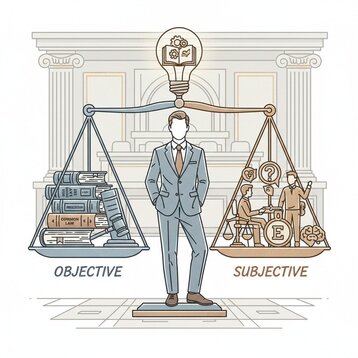

This is the black-letter law—the verifiable, external yardstick. It provides certainty and is the foundation of the Rule of Law.
- The Source: Statutes (e.g., Law of Property Act 1925) and binding precedent (stare decisis).
- The Thought Process: “Does the conduct meet the external standard of the ‘reasonable man’?”
- Example: In negligence, the test is objective. Did the driver stop at the red light? It does not matter if they believed it was green (subjective); it matters if a reasonable person would have stopped.
- Why it matters: This creates the “floor” of your argument. Without this, your case has no standing.
B. The Subjective Lens (The “Art”)
This is the internal state of mind—the “human” element involving intent, knowledge, and fairness (Equity).
- The Source: Judicial discretion, mens rea in criminal law, and the equitable maxims (“He who comes to equity must come with clean hands”).
- The Thought Process: “What was the party thinking? Is the outcome fair?”
- Example: In Harber v HMRC , the Tribunal asked: Did Mrs Harber intend to mislead the court? (Subjective). The answer was “No” (she was ignorant), but the Objective harm to the justice system remained.
- Why it matters: This creates the “colour” of your argument. It appeals to the judge’s desire to do justice, not just apply rules.
C. The Synthesis (The Expert’s Zone)
The expert lawyer knows when to deploy which lens.
- Scenario: Your client breached a contract (Objective failure).
- Expert Argument: You accept the breach (Objective) but pivot immediately to the mitigation of loss or the unconscionable conduct of the claimant (Subjective/Equitable), arguing that while the law was broken, the remedy should be minimal.
3. The Modern Toolkit: Maximizing “All Resources Available”
The modern lawyer does not just “search” for law; they curate intelligence. You must build a hierarchy of resources that moves from raw data to sophisticated prediction.
Layer 1: The Raw Data (Primary Sources) 

- BAILII (British and Irish Legal Information Institute):
- Expert Use: Don’t just read the headnote. Read the dissenting judgments. A dissenting opinion in the Court of Appeal today often becomes the Supreme Court majority opinion tomorrow. Citing a dissenting judge’s reasoning shows you understand the fragility of the current law.
- Judiciary of England and Wales (uk):
- Expert Use: Access Practice Directions and speeches by senior judges. If the Lord Chief Justice gives a speech on “The Duty of Candour,” you can bet that duty will be strictly enforced in court the following month.
Layer 2: The Radar (Commentary & Trends)
- UKSCblog (Supreme Court Blog):
- Expert Use: Use this to predict the “direction of travel.” If the Supreme Court is hearing a case on “Gig Economy Status,” you advise your corporate clients before the judgment lands. This creates “status”—you appear prophetic.
- Inforrm (International Forum for Responsible Media):
- Expert Use: For defamation or privacy, this is the gold standard. It bridges the gap between strict law and the “court of public opinion.”
- The Law Society Gazette & The Lawyer:
- Expert Use: These are for “Commercial Awareness.” Knowing that a specific firm is merging or that the SRA is cracking down on AML (Anti-Money Laundering) allows you to advise clients on regulatory risk, not just legal risk.
4. Developing Strong & Cogent Arguments
To create “status” in your writing, you must move away from the hesitant language of the student (“It acts as a safeguard…”) to the declarative language of the expert.
Step 1: The 3D Issue Identification 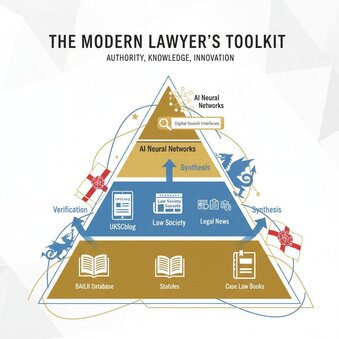

When a client presents a problem, triage it through three dimensions:
- The Legal Issue: What cause of action exists? (e.g., Breach of Contract).
- The Evidential Issue: Can we prove it? (e.g., The email chain is incomplete).
- The Moral Issue: Who is the “victim”? Judges are human; they prefer to find for the party that has “moral high ground,” even if they have to twist the law slightly to get there.
Step 2: The “Skeleton” Construction
Use this structure for every point you argue. It forces clarity and power.
| Component | Function | Expert Phrasing Example |
| 1. The Proposition | The Conclusion first. | “The Claimant’s application for summary judgment is misconceived and must fail.” |
| 2. The Authority | The “Hook” (Source). | “As per Lord Bingham in [Case X], the court must not exercise discretion where the statute is clear.” |
| 3. The Application | The “Link” (Facts). | “In the instant case, the Defendant’s conduct falls squarely within the statutory exception…” |
| 4. The Inoculation | The “Shield” (Rebuttal). | “While the Claimant will rely on [Case Y], that authority is readily distinguishable on its facts because…” |
Step 3: Language & Tone
- Avoid: “I think,” “It seems,” “Maybe.”
- Use: “It is submitted,” “The evidence demonstrates,” “The inescapable conclusion is.”
- Technique: Front-load your strongest point. If you have three arguments, put the “knockout blow” first. If the judge agrees with Point 1, they may not even read Points 2 and 3.
5. Case Study: The “AI in Law” Debate 

To demonstrate the “arguments for and against” skill, we apply the Expert Framework to the most pressing issue in modern practice.
The Issue: Should solicitors in England & Wales use Generative AI (e.g., ChatGPT, Harvey) to draft legal arguments?
A. Argument FOR (The Progressive/Commercial View)
- Efficiency as a Duty: The SRA Code requires us to act in the “best interests of the client.” If AI can review 10,000 pages of disclosure in an hour—a task that would take a junior lawyer weeks—it is arguably unethical to charge the client for manual labour.
- Access to Justice: As Lord Bingham noted in The Rule of Law, the law must be “accessible.” AI lowers the cost barrier, allowing smaller firms to compete with the “Magic Circle,” thereby democratizing high-quality legal assistance.
- The “Tool” Analogy: AI is no different from a calculator. We do not do long division by hand; why should we do boolean searches by hand? The expert lawyer uses the best tools to deliver the best result.
B. Argument AGAINST (The Traditionalist/Risk View)
- The “Hallucination” Risk (Harber v HMRC):
- The Facts: In Harber, the taxpayer used ChatGPT to generate “precedent” cases. The Tribunal found these cases were pure fiction—names and citations that did not exist.
- The Reasoning: The Tribunal held that citing fake cases “wastes time and public money” and “promotes cynicism” about the justice system.
- The Status Argument: A lawyer’s currency is their reputation. One instance of citing a fake case destroys decades of trust. The risk of “silent errors” (subtle misinterpretations by AI) is too high.
- The “Black Box” Problem: You cannot explain how the AI reached its conclusion. In court, you must be able to defend your reasoning from first principles. If you relied on AI, you are effectively saying, “The computer told me so,” which abdicates your professional duty.
C. The Synthesis (The Expert Conclusion)
The expert does not ban AI, nor do they blindly trust it. They govern it.
- The Verdict: We use AI for divergent thinking (generating ideas, summaries, checklists) but never for convergent thinking (final verification).
- The Process: “Trust, but Verify.” Use the AI to find the needle in the haystack, but then use BAILII to verify the needle is sharp and real. This approach maximizes efficiency (Argument For) while eliminating the risk of hallucination (Argument Against).
6. Conclusion
The modern expert lawyer is a paradox: they must be as old-fashioned as the Year Books in their rigour, and as modern as the latest algorithm in their efficiency.
By mastering the dialectic between Subjective fairness and Objective law, and by utilizing resources like UKSCblog and BAILII to verify every strategic move, you create a practice that is bulletproof. The expert is not the one who knows everything; the expert is the one who knows where to look, how to argue, and why it matters.
Resources Used: BAILII, Judiciary.uk, UKSCblog, Inforrm, Law Society Gazette, SRA Competence Statement, Harber v HMRC UKFTT 1007 (TC).
- https://www.tandfonline.com/doi/pdf/10.1080/14735970.2023.2287430?needAccess=true
- https://www.sra.org.uk/solicitors/resources/continuing-competence/competence-statement/
- https://uollb.com/blogs/uol/bingham-s-eight-principles-of-rule-of-law
- https://uollb.com/blogs/uol/subjective-test-vs-objective-test
- https://www.sackers.com/pension/harber-v-hmrc-first-tier-tribunal-4-december-2023/
- https://www.allaboutlaw.co.uk/law-courses/sqe/what-are-the-sra-competencies
- https://uollb.com/blogs/uol/lord-bingham-and-rule-of-law
- https://www.pastpaperhero.com/resources/uk-legal-objective-test-law
- https://www.25canadasquarechambers.co.uk/news-and-events/ai-caramba-do-you-see-what-ai-see/
- https://www.sra.org.uk/pdfcentre/?type=Id&data=1950336330
- https://www.counselmagazine.co.uk/articles/the-rule-of-law
- https://onlinelibrary.wiley.com/doi/pdfdirect/10.1002/iir.1382
- https://immigrationbarrister.co.uk/the-second-tier-appeals-test-objective-or-subjective/
- https://ts-p.co.uk/insights/landmark-ruling-first-tier-tax-tribunal-warns-against-ai-reliance-in-case-preparation/
- https://www.yorkshirecoursesforlawyers.co.uk/sra_competence/
- https://academic.oup.com/bjc/article/50/6/1202/413970
- https://lcls-south.com/the-reasonable-man-subjective-and-objective-standard/
- https://www.nortonrosefulbright.com/en-gb/inside-disputes/blog/202401-be-wary-of-unverified-ai-generated-content-in-litigation
- https://www.lawsociety.org.uk/career-advice/career-development/continuing-competence/sra-competence-statement
- https://ppotoda.org/wp-content/uploads/2024/01/Lord-Bingham-The-rule-of-law.pdf
- https://core.ac.uk/download/pdf/334499300.pdf
- https://binghamcentre.biicl.org/our-vision
- https://www.tandfonline.com/doi/pdf/10.1080/10854681.2023.2267400?needAccess=true
- https://www.tandfonline.com/doi/pdf/10.1080/09649069.2021.1880167?needAccess=true
- https://journals.sagepub.com/doi/pdf/10.1177/14737795231166966
- https://academic.oup.com/ojls/advance-article-pdf/doi/10.1093/ojls/gqae002/56708492/gqae002.pdf
- https://www.cambridge.org/core/services/aop-cambridge-core/content/view/F21D9CBFA92A5917901429261FD6FB20/S0008197322000526a.pdf/div-class-title-discerning-the-form-at-the-second-stage-of-vicarious-liability-div.pdf
- https://www.tandfonline.com/doi/pdf/10.1080/13600869.2021.1999075?needAccess=true
- https://www.levyandlevy.co.uk/when-relying-on-artificial-intelligence-is-not-so-intelligent/